Safari Planning

A Typical Day on Safari!

Everyday is a different day on Safari. No agendas; just you and your Safari guide making plans on what to see, where to go, how long to be out, and more. Here are guidelines to navigate your day on a East African Safari.

Morning.
For the most part, waking up early should be the norm even if you are not a morning person. Why? Sunrise. This time of the day is truly glowing. 

Your wake-up call can be any where from 6:00 am onwards.

1. You can decide to have breakfast at the lodge. Enjoy coffee in your room, then head to the main area. Majority of the Safari lodges in the national parks have a deck looking out at the park. Enjoy the sunrise while eating breakfast.  
2. Start around 6:30 am and go out looking for wildlife in the early morning, when the sun is lighting up the African soil. Have breakfast around 8:30 -9:00 am [or when your stomach calls for food] in the middle of the national park. This should be your choice at least once or twice in each national park.

Zebras at Sunrise in the Laikipia, Northern Kenya

Afternoon.
Depending when you have started, you will have two choices. 

1. Stay out for lunch in the parks. If you have stayed in for breakfast, go out and stay out for a bit longer. There are many picnic spot your guide will take you or in some cases, you will eat in the car while watching the rhino crawl or in the middle of the Wildebeest Migration.
You can come back to the Safari lodge at your own leisure for your afternoon siesta.

2. Come back for lunch at the Safari lodge. If you have been out from early morning, this can be an option. And if you want, squeeze in an outdoor shower when the sun is out. 

Late afternoon / Evening.

Around 3:30 - 4:00 pm, you will be heading out again if you have been in the Safari Lodge. Go out to capture the evening golden hour. If you've had enough for the day, stay back. There are no rules. 

You will be out and about until 6:30 pm, stretching it to 7:00 pm before you have to return back. Many a rush drive back have been had as you want to soak in every last light on Safari.
Also, this is the time for sundowners. The time you park your vehicle, enjoy a drink while watching the glorious sunset in Africa. You will pinch yourself, you are on Safari.

Afternoons at camp sometimes mean snoozing and reading a good book, or playing games!

Night-time.

Pure cozy. Campfire, Safari stories by the camp manager or staff + a delicious dinner.
Some stories that have to be heard like this Maasai warrior telling us about his right of passage by hunting lions. Keep an open mind - it's not all black and white, lots of grey, lots of changes that need to be made, lots of traditional ways that have to alter, lots of cultural stories that need a new course - listen and be curious.

Evenings by the fire - stories, laughter. All of it.

In the end, you decide your travel style. Some clients want to be out all day; they want to soak every minute of being on Safari. Others want to relax a bit more; have all meals or more meals at the lodge and go out on game drive at leisure. 

Whatever your style, you will love everyday on Safari. 

Let's get going already! What to pack on your African Safari?

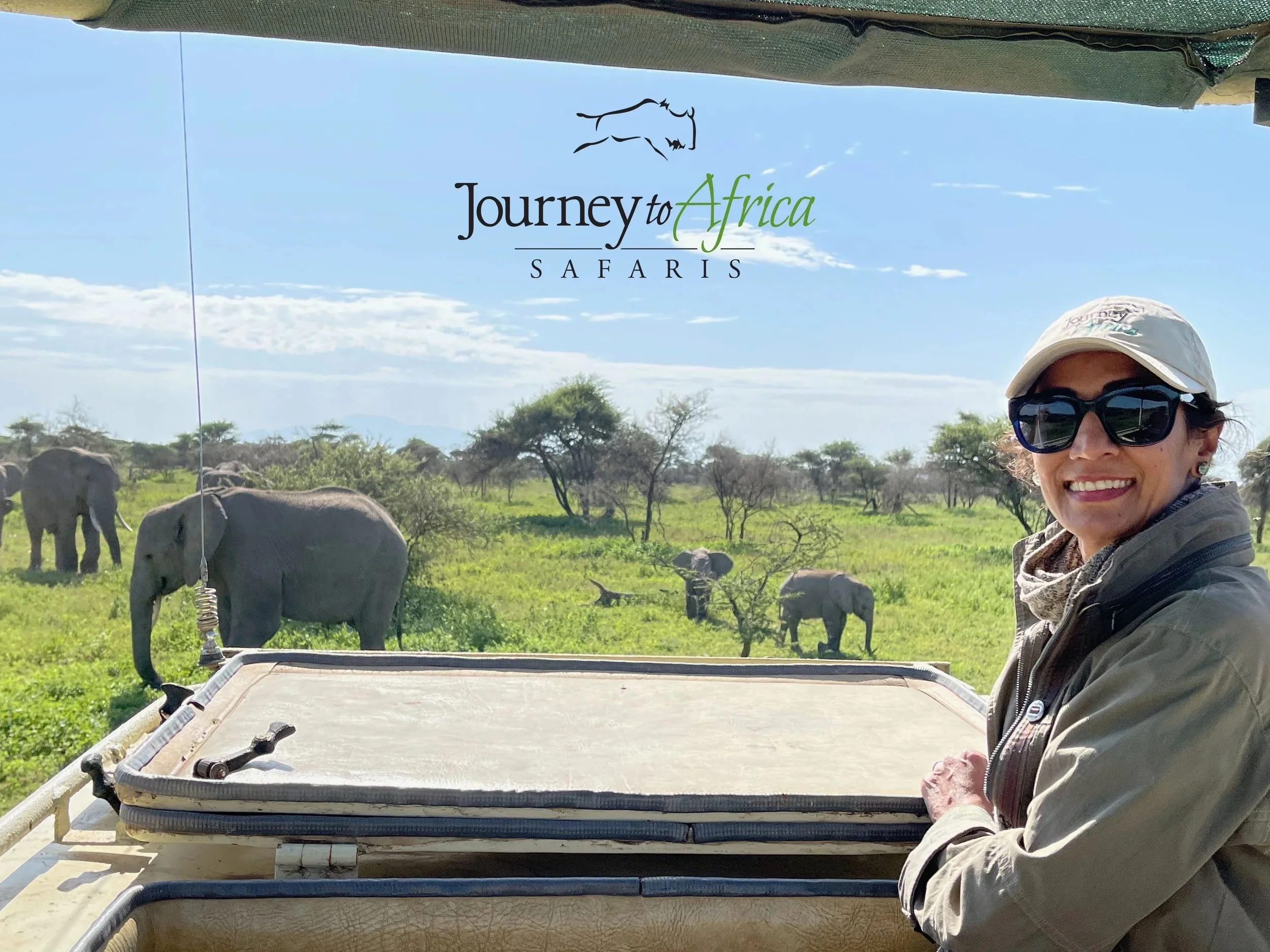
Me, Mefi on a kopje in the Serengeti.

They say that the anticipation phase of a trip is just as exciting as the actual adventure.
I agree. Even after 25+ years of Safari Planning, and a childhood full of Safaris in my home country of Tanzania, I still get goosebumps when thinking about Safaris. Safari is just thrilling. The wildlife, oh the amazing range of wildlife, the people - my friends, the landscape, and the life-altering conversations that you are about to experience. Goosebumps.

Lets talk Temperature:
Okay, here's something about Africa - it is large. Africa has 54 countries, 11.5 million miles with a range of temperatures. Something that suprises most people who travel to East or Southern Africa for their Safari is that it does get cool/cold. We're talking 40s during the early mornings and evenings if you are in areas like Ngorongoro. [Weather guideline]. The days are typically warm, but in the early morning, open vehicles and wind also make it cooler. You knew? Awesome. A fleece or sweater is a must. Scarfs may be necessary as well for those like me who get cold faster.

Luggage:
The main advise is to stick to a soft sided case [no hard shell suitcases!]. I have a Samsonite carry-on bag that I use as my main bag, but as long as it’s soft sided, you can take a normal sized hold bag. The reason for soft sided bags is that they need to squeeze the luggage compartment in the small bush planes during your travel. If you can only use one carry-on bag while keeping with your airline’s check-in policy [please check as each airline has different weight limits], more power to you. Otherwise, one carry-on bag/back-pack to keep essentials, clothing for a day or two [should your bags not arrive on time], and the other carry-on bag to check-in.

Note: For Botswana & some other Southern African countries, the bush flights are much mre strict and you bust have a soft sided duffel without a handle etc, like the bottom left green pictured below.

Baggage Guidelines to help you visualise!

The thing to keep in mind is the approx 35-44 lbs weight limit for the bush planes on Safari.
Do not pack more than that if you can. If you can’t keep with the weight limit, tafadhali [please] let us know in advance. We can buy you freight weight which costs a little extra but at least you have more weight to work with. Photographers, we hear you! We do this often.

What to pack on Safari :
– A warm sweater and/or fleece for the evening. If going in cooler months, June to September/October, both would be a good idea. Always check weather.com before you leave. They have temperatures for many of the Eastern and Southern African parks.
– 2-3 pants. If they that zip off to become shorts may work especially during the hot season.
Ones I wear on Safari are Kuhl, Athleta and Baleaf. My husband and son wear these pants.
- 3-4 short sleeve tee for the day time which you can rotate. Layering is key as it will be cold in the morning and evening but warm up during the day.
– 3 long sleeve shirts to layer for the mornings and evenings time. Mix and match is the way to go.

Ladies, sneak in a light jewelry for instant glam or get one at your Safari Lodge.

Colors - neutrals are recommended because you are blending in the environment but if you do wear black or blue, like me, it’s all good. Comfort is more important as you will be sitting for a long time.

Evening dressing:
Sometimes in the evening, you end up wearing what you wore on the game drive - no worries. No one is looking. Enjoy the sunset if it mean staying as long as it is allowed by park authorities and rushing back for campfire drinks instead of going for your shower and missing the light.

– Scarf or bandana. The scarf/bandana can be used as a mask again dust, protecting your neck from the sun, keep you warm during the windy drives, and those times you need a wipe. If small, sneak in another one so it can stay clean. 
– Closed-toe shoes. There will be some sort of walking on every Safari - even from your room to the dining tent. Closed toe shoes also to keep anything from biting you.
- Socks. Add a pair [or two] of warm socks especially during the cooler months. Remember - reduce. reuse. recycle - unless you think you need more than two pairs because only you know your body well enough. 
–  Sandals. I have my Birkenstock which I like as sometimes I can wear these during game drives. A good idea to pack for the comfort in your tent.
– Wind-jacket. Highly recommend this especially since a lot of the vehicles on Safari are open. The morning and evening wind does get chilly. If it is also rain-proof, even better. Kuhl, Patagonia, Athleta, etc. have choices.
– Sun hat and sun glasses of course. We do give you a Journey To Africa baseball cap either in the US or on arrival.
– 4-5 undergarments preferable quick dry ones so you can wash overnight. In most of the lodges, they will provide soap to wash. Ladies, undergarmets will not be washed by the lodge crew.
- Ladies, sports bras are good option here as the roads can be bumpy. I have had a few guests appreciate this advise.  

* One thing to note is that most lodges we recommend have laundry included or if not, there is a nominal fee for laundry. Take advantage of this service.

Mefi’s Personal notes:
- I have loved having a fanny pack on my Safaris recently. I always carry my documents and money with me and this has been the best hands-free option for me. My back-pack with my camera, etc. can be left behind, but my valubables go with me at all times.
- I love the efficiency of my IPhone. I purchased a lanyard from Amazon and I must say, this has been a game-changer for me. The phone does not accidently drop on the hard surfaces when I am shooting with my camera. I used to rely on pockets but with the new ‘large’ phones, they fall off so this is an un-safe option. I met a lady on Safari who lost her phone on Safari and I was so thankful for my lanyard as my phone was on my for the whole time.

Guys, there are a few modification you would need to make but you get the idea of what is necessary.

Georgie’s notes:

I love to have a little notebook or small journal to write down highlights of the day and what I saw - you’ll see so much that it’s so special to look back on and remember little details you otherwise would have forgotten! I have done this since I was a little girl!

Personal items:
– Hand wipes. For those times when you have to eat lunch after your game drive and you need to wipe off the dust. Dispose of them properly in the camp.
– Shampoo + conditioner travel size. Though I have to say, I used the lodge-provided shampoo + conditioner the past couple of Safaris, and my hair and I survived. 
SPF 30+ [one I use] is a must on Safari.
- Lotion as it can be dry air on Safari. Our preferred lodges usually offer this but a compact one in your hand luggage may be a good idea. I speak from cracked hands experience. Vaseline too for around the nose if you are really sensitive.
- Nail cutter. If you are like me and want short nails so they look clean. Plus, if you are going to be on Safari for longer than 2 weeks, this may be an overlooked item. 
– Flashlight - for walking from your room to the mess tent or should you need to go to your enclosed restroom at night, this may come in handy. Most lodges turn off their lights after a certain time. Most of the camps we suggest will have this but not a bad item to have. OR, use your IPhone flashlight option if you have an IPhone.
– Mosquito repellant wipes or band.
– Medical first-aid kit. Take your prescriptions as a carry-on. A must!!
Then you have band-aid, Neosporin, cortisone cream, Immodium [you never know], Pepto-Bismol [read this article and decide if you want to do this on your Safari], Advil or Tylenol, muscle relaxing balm +. This is just a sample.
– Contact wearers, there is dust on Safari. I always have my glasses as backup. I take extra contacts in case I need to put on a fresh pair mid-day. Remember to clean your hands first.
– For those who need a little make-up to feel put together, go ahead, take a small pouch. If you feel good, you enjoy yourself more. Keep strong perfumes/colognes at home. An insect magnet.

Extras:
- Consider a white noise app in your phone for the light sleepers or those who would like to sleep in a bit - birds especially don't know you are on holiday.

Happy Packing!

Let us know if you need any help. We have been doing this for 25+ years and love to help people make their Journey to Africa dreams a reality - and take the overwhelm out of Safari planning!